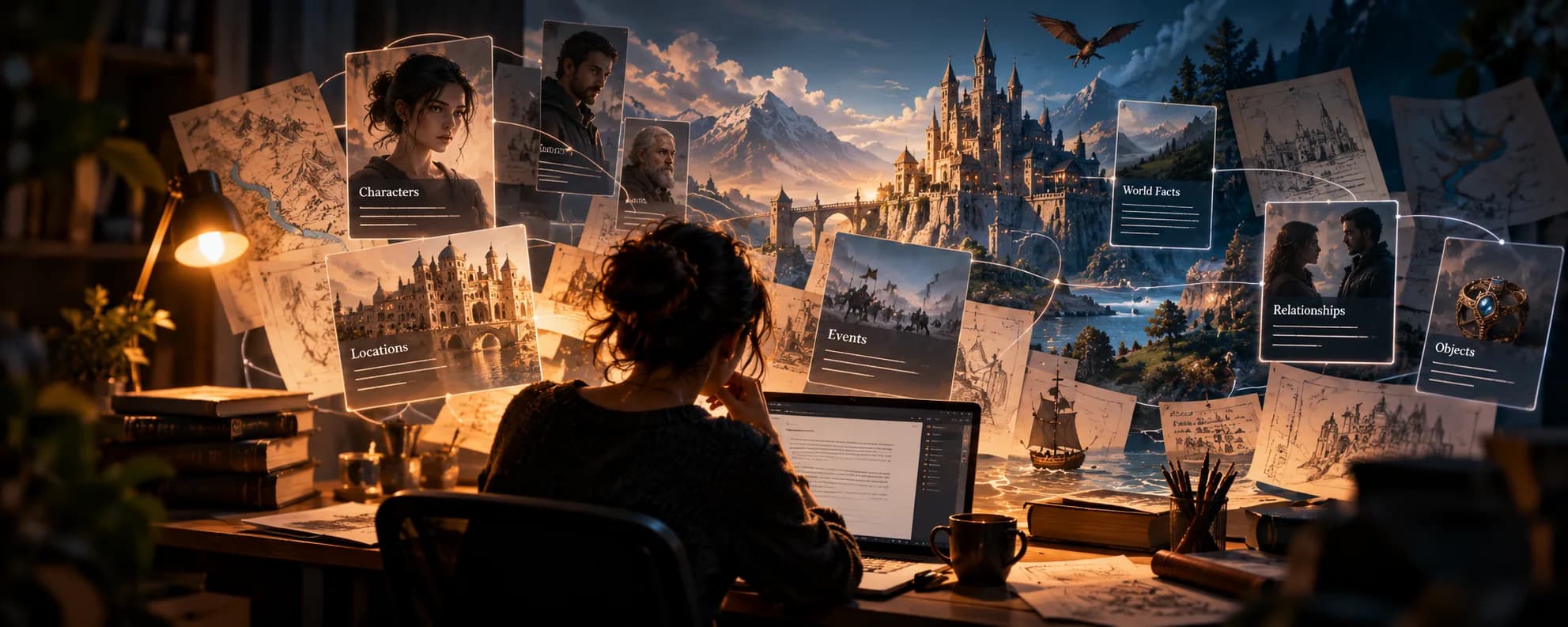

What Is a Story World and How Can You Build One in Lines?
Every story exists inside a world. Sometimes that world is a fictional continent with its own history, governments, cultures, and rules. Sometimes it is simply a neighborhood, a university, a family home, or even a single room shared by a handful of characters. Whether you are writing fantasy, science fiction, romance, crime, or a completely realistic story, your characters never exist in a vacuum. Their decisions, relationships, conflicts, and experiences all happen within a larger context.
A story world is the collection of characters, locations, events, relationships, objects, facts, beliefs, and rules that make a story feel coherent and believable. As a story grows, keeping all of that information in your head becomes increasingly difficult. A minor character introduced several chapters ago, a past event, a relationship between two people, something a character knows or does not know yet, or even the distance between two locations can suddenly become important much later in the story.
Story World in Lines was built for exactly this problem. It gives writers a structured space alongside the story itself where they can build, organize, and expand their fictional world as the story develops. But the goal is not simply to create a separate encyclopedia for your story. In Lines, the Story World connects directly to the writing process, branching stories, collaboration, and even the reader experience.
Story Worlds Are Not Just for Fantasy
When people hear the term worldbuilding, they often think of enormous fictional universes like Westeros, Middle-earth, or large science fiction settings filled with maps, dynasties, wars, languages, and centuries of history. But worldbuilding is not limited to stories like these.
Imagine you are writing a story about three friends at a university. The university itself, the dormitory, the café where they meet, their families, their past experiences, and the relationships between them are all part of the story world.
Even in a short story, a writer usually knows more about the characters and setting than the reader will ever see directly on the page. Those hidden details still influence behavior, dialogue, atmosphere, and narrative consistency.
As a story becomes longer, more serialized, or more complex, managing this information becomes increasingly important. A character introduced in chapter three might return in chapter twenty, and a small detail from their past may suddenly matter again.
A well-structured story world effectively becomes a second memory for the writer.
How Story World Works in Lines
In Lines, every story can have its own Story World. Writers can create and manage characters, locations, objects, events, relationships, and other important elements of the narrative in a structured way.
Instead of keeping character notes across multiple documents, notebooks, or scattered files, each important element can have its own place inside the world. Writers can add facts, background information, relationships, and other details, then continue expanding them as the story evolves.
This becomes especially useful in larger stories. A novel may begin with only a few central characters and locations, but after months of writing it can contain dozens of characters, multiple timelines, complex relationships, and events that affect one another.
Lines does not require writers to design the entire world before they begin writing. You can start with only a few characters and places, then expand the world naturally as new parts of the story emerge.
See What a Character Knows at Any Point in the Story
One of the most important differences between Story World in Lines and a traditional worldbuilding tool is that world information does not have to remain separate from the writing environment.
While writing, authors can access information related to the exact point where the cursor is currently located in the story.
This becomes especially useful when a character's knowledge, opinions, beliefs, or relationships change over time. In a long story, it is not enough to know what is true about a character in general. The writer often needs to know what that character knows at a particular moment in the narrative.
For example, the reader may already know a secret that the protagonist has not discovered yet. A character may believe something in chapter ten that changes after a major event in chapter fifteen. Two characters may still consider each other allies at one point in the story, even though that relationship changes later.
With the At Cursor concept in Lines, information can become contextual to the writer's current position in the story. Instead of treating the Story World as a static database, the writer can see what matters at that point in the narrative, including what specific characters know, believe, or understand at that moment.
This helps writers avoid one of the most common continuity mistakes in long-form fiction: allowing a character to act on information they should not yet have.
Characters, Locations, Events, and Relationships as a Connected System
A story world is more than a collection of isolated profiles. Characters have relationships with one another, events happen in specific places, objects may belong to particular people, and something that happened years ago may still influence the decisions of several characters in the present.
That is why Story World in Lines is designed around connections as much as individual pieces of information.
Writers can record who participated in an event, where it happened, how two characters are connected, and which facts belong to different parts of the world. A war from decades ago, the first meeting between two characters, a journey, a betrayal, the discovery of a secret, or an accident that changed a character's life can all become part of the history of the world.
Some of these events may appear directly in the story. Others may exist entirely in the background while still shaping everything that happens on the page.
As a fictional world becomes more complex, these connections become increasingly important. Complexity itself is not the problem. The real problem begins when the writer can no longer reliably follow the relationships, causes, consequences, and history inside the story.
A structured Story World helps keep that complexity manageable.
Give Readers More of the World Without Overloading the Main Story
Not every interesting detail belongs in the main narrative.
Writers often create background information that helps make the world richer but would interrupt the pacing if it were inserted directly into scenes or dialogue. The history of a family, the background of a city, the structure of an organization, the origin of an important object, or cultural details about a fictional society may all be valuable without belonging in the main text.
In Lines, writers can make selected parts of the Story World available to readers.
This creates two layers of storytelling. The main narrative can remain focused and well paced, while readers who want to explore more deeply can discover additional information about the world outside the main text.
For stories with large or complex settings, this means the Story World can become part of the reading experience itself rather than remaining only a private tool for the author.
The writer still decides what is visible and what remains private.
Managing Story World Access in Branching Stories
Lines is built around branching storytelling, and that creates a challenge that traditional writing tools rarely have to solve.
If another writer is going to create a branch from your story, how much of your world should they be allowed to see?
A Story World may contain information that has not yet been revealed to readers. It might include the true identity of a character, the outcome of a future plotline, hidden relationships, unrevealed history, or details that are essential to the original author but should remain secret from everyone else.
For this reason, authors can control how secondary writers access Story World information when working on branching stories.
Private information can remain hidden, or selected information can be made available when necessary. Access to protected parts of the world can also be tied to accepting responsibility for confidentiality and non-disclosure.
This allows collaboration without forcing the original author to expose the entire creative foundation of the story.
A secondary writer may need access to the rules of the world, the history of certain characters, or specific background events in order to write a branch that remains consistent with the original work. But that does not mean they need unrestricted access to every secret, future reveal, or unpublished element of the story.
The original author remains in control of how much of the world is shared.
One World Can Support More Than One Story
Some fictional worlds are larger than a single story.
An author may finish one novel and later decide to write a sequel, prequel, spin-off, side story, or an entirely different story set in the same universe. Rebuilding every character, location, rule, historical event, and relationship from the beginning would be inefficient and could easily introduce inconsistencies.
Lines allows writers to copy a Story World for use in another story.
More importantly, that copy does not have to be all or nothing. Writers can choose the level of detail they want to carry into the new story.
In one project, the author may only need the basic world structure, locations, and core rules. In another, they may want to bring over characters, relationships, historical events, and more detailed information.
This level-based approach allows the same fictional universe to become the foundation for multiple stories without forcing writers to duplicate everything manually or carry over information that is irrelevant to the new work.
For writers building a series, shared universe, spin-off, or anthology, the Story World can gradually become a creative asset of its own rather than something tied to a single story.
Worldbuilding Should Not Replace Writing
One of the easiest mistakes to make in worldbuilding is believing that everything must be designed before the first chapter is written.
Some writers genuinely benefit from creating extensive histories, maps, cultures, and character profiles before beginning. For many others, however, worldbuilding can quietly become a form of procrastination.
It is easy to spend hours designing details that may never have any meaningful effect on the story.
Another approach is to let the world grow alongside the narrative.
You can begin with only the main characters, a few important locations, and several essential facts. When a new character appears, add them. When a past event becomes relevant, record it. When a relationship becomes more complex, expand its information.
In this model, the Story World becomes a living document that evolves together with the story.
That is the philosophy behind Story World in Lines. The system should not become another obstacle that writers must complete before they can begin. It should be available whenever it becomes useful and grow only as much as the story requires.
From Worldbuilding to Narrative Consistency
One of the hardest parts of writing long-form fiction is maintaining continuity.
A writer may forget what a character knew at a particular moment, whether two people were already aware of each other, how far apart two locations are, whether an event happened before or after another one, or how a particular detail was described several chapters earlier.
These problems become more common as the amount of information in a story exceeds what a writer can comfortably keep in memory.
In branching stories, the problem becomes even more complicated because several writers may be developing different parts of the same universe while each of them should only have access to certain information.
The purpose of Story World is not to reduce creativity to forms and data. The opposite is true.
When writers no longer need to spend as much mental energy remembering hundreds of details, they have more space to focus on plot, character development, dialogue, and the actual act of writing.
The Future of Story World in Lines
The current version of Story World is only the beginning of what we are building.
The long-term goal is not to create another static encyclopedia beside the story. Story World is intended to become an active part of the writing environment, capable of bringing the right information to the writer at the right moment.
Over time, intelligent features in Lines can make greater use of this structured world information to understand the relationships between characters, locations, events, and facts.
For example, if something written in a new chapter conflicts with a previously established fact, the system could help identify that inconsistency. If a character behaves according to information they should not yet know at that point in the story, the same structure could help surface the problem.
The Story World can therefore become more than a place where information is stored. It can become the structured memory of the story itself, a memory that the author, writing tools, secondary writers, and even readers can interact with at different levels of access.
The purpose is not for the system to decide how the story should develop. The world, the characters, their beliefs, their secrets, and their decisions still belong to the writer.
Technology should handle more of the difficult information management so writers can spend more of their time doing what matters most: creating and telling stories.
The World That Lives Behind the Story
Readers may never see every detail you create for your fictional world.
They may never learn the full history of a building, the background of a minor character, or the reason a city that appears only once has a particular name. But those details still help the writer create a world that feels consistent and alive.
And when the author chooses, some of that hidden world can move beyond the background and become part of the reader experience.
Worldbuilding is not about making a story unnecessarily larger. It is about understanding the world your characters live in and maintaining control over the information that exists at every point in the narrative: what the author knows, what each character knows, what the reader is allowed to discover, and how much a secondary writer is allowed to see when creating a new branch.
Story World in Lines was built so this information no longer has to live across scattered notes, documents, and memory.
Writers can build their world, access relevant information while writing, understand what characters know at the current point in the story, reveal additional material to readers, control access for branch writers, and reuse the same world across entirely different stories at the level of detail they choose.
Every story begins with a blank page.
But behind the best stories, there is usually a much larger world than the one we can see on that page.